What is OM5 fiber and how is it different than OM4 & OM3?
Designing fiber optic networks was never easy, but over time, the challenges have shifted. There are more tools than ever to help you optimize every corner of your network. At the same time, increasing options make it more difficult to find satisfaction with the choices you make. That holds true with selecting your fiber cables. So far, the options between singlemode and multimode networks were self-selecting. As for multimode systems, the somewhat narrow range of variety made that selection a little easier as well. Now, OM5 is on the rise, and it brings with it a new niche combination of performance and cost-effectiveness. Is it right for your systems? A quick read will help you determine the answer.
What Is OM5 Fiber?
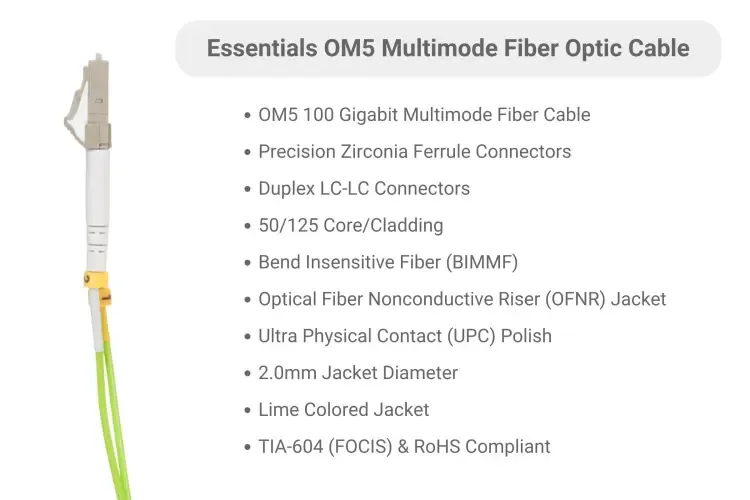
As the name suggests, OM5 is a multimode fiber cable. It’s fairly new to the industry, and it is designed specifically for high bandwidth and short to medium range applications. What makes it more than just the next iteration of OM cable is the new take on multiplexing. OM5 is the first approved as WBMMF (Wide Band Multimode Fiber) is designed to specifically handle high-speed data center applications with using two fibers to transmit from 40GBs up to 100GBs and is powered by shortwave wavelength division multiplexing (SWDM). This multiplexing design allows OM5 to dramatically reduce parallel fiber counts. Operating in the 850 to 950 nm range, OM5 can provide 100 GB data streams with just one pair of parallel fibers.
With fewer fibers comes reduced crosstalk and overall lower loss. What’s more is that OM5 can utilize four separate wavelengths in its range, and channel loss is consistent across each frequency.
Comparing OM3 and OM4
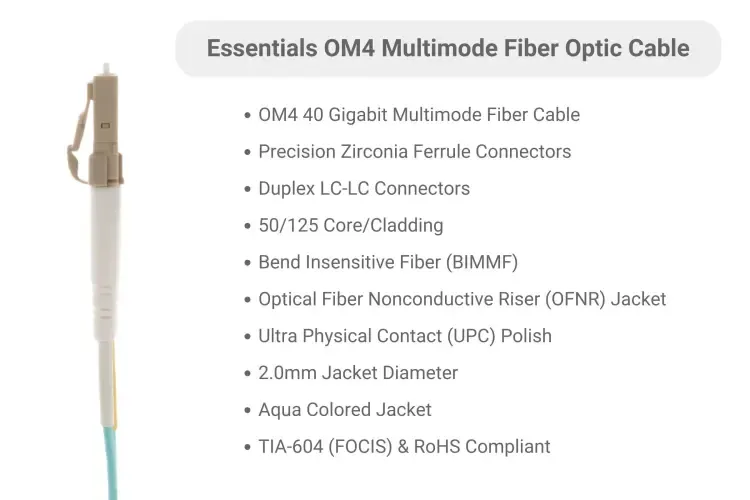
For those familiar with the previous iterations, OM3 and OM4 offered substantial bandwidth increases over their predecessors. By switching to laser signaling, they were able to boost performance substantially without sacrificing multimode advantages. They may cost more than their LED counterparts, but OM3 and OM4 have been competitive fiber options for data centers.
OM5 aims to raise the competition. It is capable of notably faster data transmissions, and when running at the same speed as OM3 and OM4, OM5 can provide longer connections without significant loss. You can see the comparisons below.
Expected SWDM Data Rates
| OM3 | OM4 | OM5 | |
|---|---|---|---|
| 40G SWDM | 240 m | 350 m | 440 m |
| 100G SWDM | 75 m | 100 m | 150 m |
OM4 vs OM5 Distance Comparison
| Type | OM4 | OM5 |
|---|---|---|
| 10BbE | 400 m | 400 m |
| 40GbE | 150 m | 150 m |
| 100GbE | 150 m | 150 m |
| 40G SWDM4 | 400 m | 500 m |
| 100G SWDM4 | 100 m | 150 m |
The last worthy note is compatibility. OM5 is cross compatible with OM3 and OM4 systems. That makes it ideal for incremental upgrades that won’t sacrifice your existing infrastructure.
Applications for OM5
OM5 does once again raise the cost per foot of cable over its predecessors, but it offers performance that many data centers are now demanding. The longer transmission lengths help with expandability. In fact, the specs on OM5 make it perfectly suited for the next generation of data centers. It will maintain steadily increasing speed demands without costing as much as singlemode alternatives.
Speaking of singlemode fiber, it still remains the champion for highest speeds and longest distances. You’ll find that singlemode cables are still the clear choice for outdoor and long-range networking. However, when cost matters and OM5 can meet performance needs, it’s a clear favorite for high-demand indoor networking.