Choosing the right Ethernet cable is crucial to ensure the best network speed for home gaming sessions and professional purposes. In this article, we will compare Cat7 and Cat6a cables, discussing their specifications, performance, and applicability in different scenarios.
Cat7 vs. Cat6a: What’s the difference?
What is Cat7?
Cat7 cables are also known as Category 7 cables. They are designed to transmit data at speeds up to 10 Gbps to 40 Gbps over a good distance. They were introduced to support higher frequencies of up to 600 MHz, making them suitable for modern high-speed networking needs.
What is Cat6a?
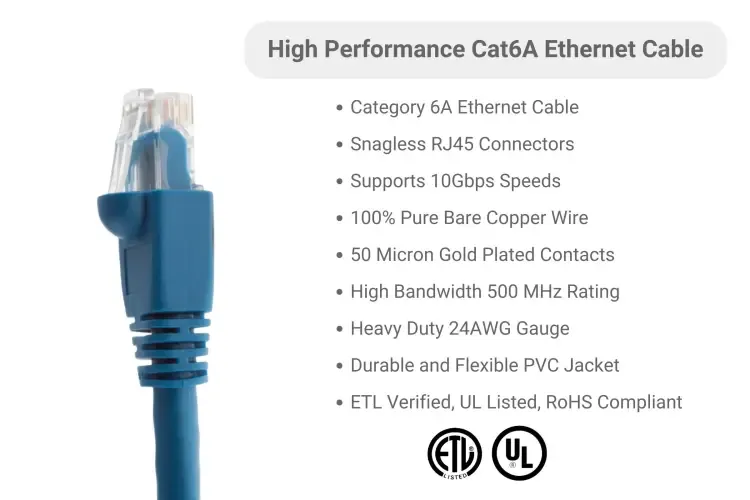
Cat6a cables, or Category 6a cables, offer an improvement over the previous Cat6 standard. They support frequencies up to 600 MHz and data transfer speeds of up to 10 Gbps over 100 meters, providing a cost-effective solution for high-speed networking.
Specifications and Performance: Cat6a vs Cat7
- Cat7 Specifications
Cat7 cables offer twisted pairs of shields that enhance noise resistance with a maximum bandwidth support of 600 MHz. These are recommended for surroundings with a lot of electromagnetic interference (EMI).
- Cat6a Specifications
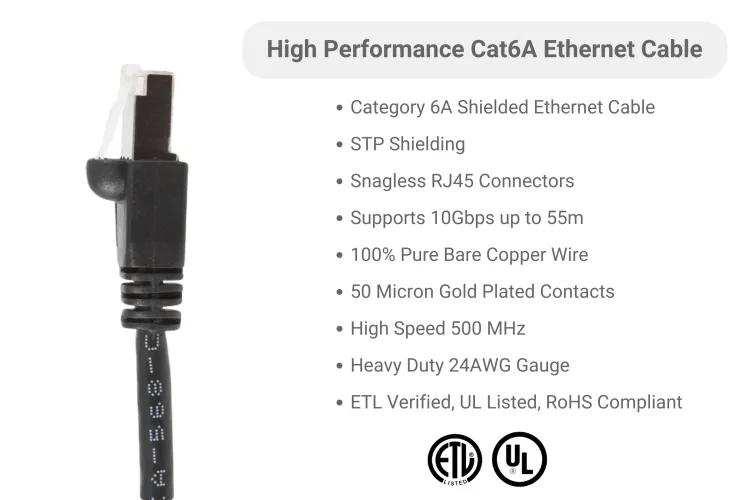
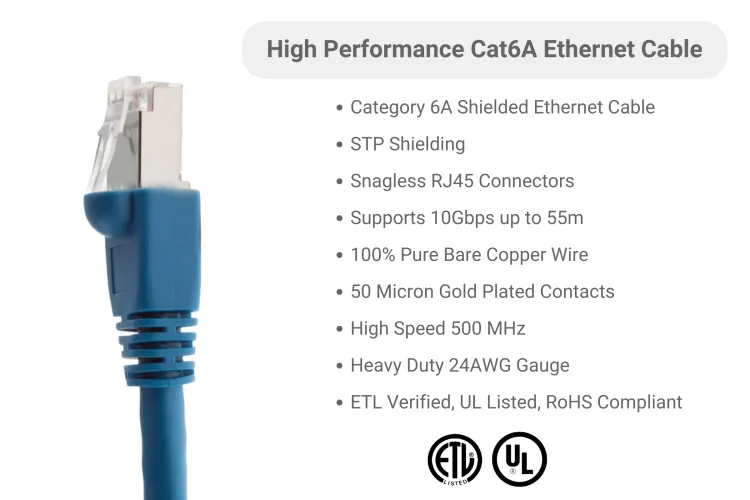
Cat6a cables support a bandwidth of 500 to 600 MHz, providing Unshielded Twisted Pairs (UTP) and Shielded Twisted Pairs (STP) options. They are suitable for high-speed data transfer and reliable performance in various conditions.
Bandwidth and Speed: Cat6a vs Cat7
- Cat6a
Cat6a cables can support up to 10 Gbps at a maximum distance of 100 meters, making them suitable for most modern networking needs, including high-speed internet and data transfer.
- Cat7
Cat7 cables support speeds of up to 40 Gbps over distances of up to 50 meters, ideal for demanding applications requiring ultra-fast data transmission.
Distance and Length
- Cat7
Cat7 ethernet cables can maintain 10 Gbps speeds over a maximum distance of 100 meters, making them suitable for extensive installations in large buildings or data centers.
- Cat6a
Cat6a network cables also support 10 Gbps speeds over a distance of 100 meters, offering a balanced solution for both residential and commercial installations.
Speed and Usage
- Cat7
Cat7 cables have common use in data centers, enterprise networks, and environments that require strong shielding against EMI. They are appropriate to use when you want to transmit large amounts of data quickly such as during video streaming as well as in professional audio or video installations.
- Cat6a
Cat6a cables are versatile, used in both residential and commercial settings for gaming, streaming, and general high-speed internet applications. They offer a good balance between performance and cost.
Shielding Comparison: Cat6a vs. Cat7
- Shielding in Cat6a
Cat6a cables are available in both UTP and STP variants. The STP variants offer additional protection against interference, making them suitable for environments with moderate to high EMI.
Cat6a cables typically have an overall shield to protect against external interference, making them more reliable in environments with high electromagnetic interference.
- Shielding in Cat7
Cat7 cables typically features S/FTP (Shielded/Foiled Twisted Pairs) construction. This includes individual pair shields in addition to an overall cable shield, providing superior protection against crosstalk and EMI. The increased shielding of Cat7 cables makes them ideal for industrial and high-interference environments, such as data centers, where minimizing interference is crucial for maintaining network performance.
Interference Comparison: Cat6a vs. Cat7
When comparing the shielding and interference protection between Cat6a and Cat7 cables – Cat7 offers superior performance. The S/FTP construction of Cat7 cables provides better protection from crosstalk and external signals than the STP and UTP variants of Cat6a. This makes Cat7 cables more suitable for environments with high levels of electromagnetic interference, ensuring more reliable and stable network performance.
Technical Details
- Wire Gauge and Diameter: Cat7 vs Cat6a
Cat7 cables generally have a thicker diameter and a larger wire gauge compared to Cat6a cables, which can affect the ease of installation and conduit fill requirements.
- Installation Considerations
For both Cat7 and Cat6a cables to perform as expected during their installation, they have to be installed with care.
Comparatively, Cat7 cable has thicker shielding which can make it harder to install in cramped areas than cat6a cable due to its more flexibility.
Cost and Availability
- Price Comparison
Cat7 cables tend to be more expensive than Cat6a cables due to their enhanced shielding and higher performance capabilities. However, for most residential and small business applications, Cat6a provides a more cost-effective solution.
- Market Availability
Cat6a cables are more widely available and come in various configurations to suit different needs. Cat7 cables are less common but are available from specialized suppliers for specific high-performance requirements.
Future Trends
- Upcoming Technologies
Future advancements in Ethernet technology may see the introduction of even higher categories of cables, such as Cat8, which are already on the market with support for frequencies up to 2000 MHz and data rates up to 40 Gbps over shorter distances.
- Potential Developments
The development of high-speed, better-shielded, easier-to-handle cables will continue as network demands increase. Cat6a’s and Cat7’s relevance shall further be affirmed in situations where fast data transfer without interference is vital, now that network requirements continue developing.
Conclusion
Both Cat7 and Cat6a cables have their advantages for fast internet connections. Cat7 cables are great at blocking interference and can handle faster speeds than other cables.
Cat6a, on the other hand, is more affordable and works well for homes and offices. It offers reliable performance without the higher cost of Cat7 cables.
When deciding between Cat7 and Cat6a, consider what your network needs and budget are. Choose the one that fits best for you. For more information and options, scroll down to the links below!
Additional Learning Center Resources